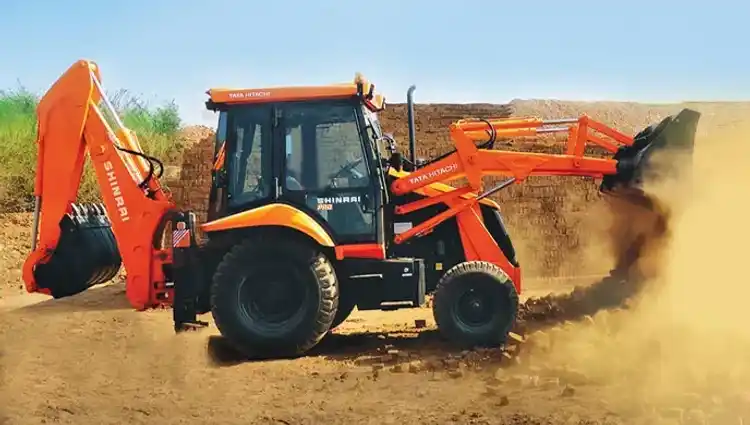
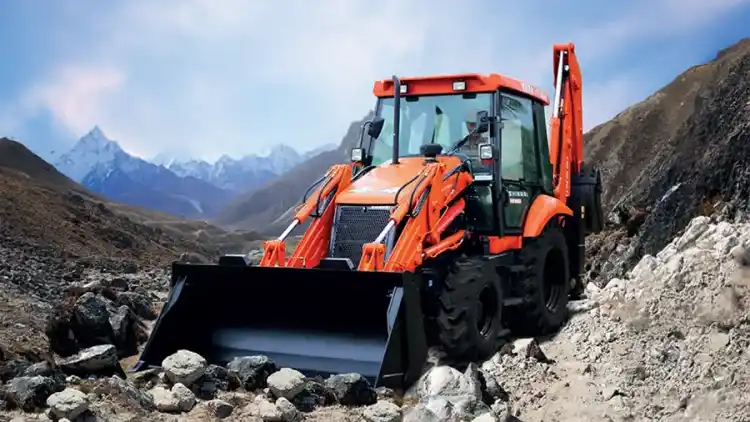
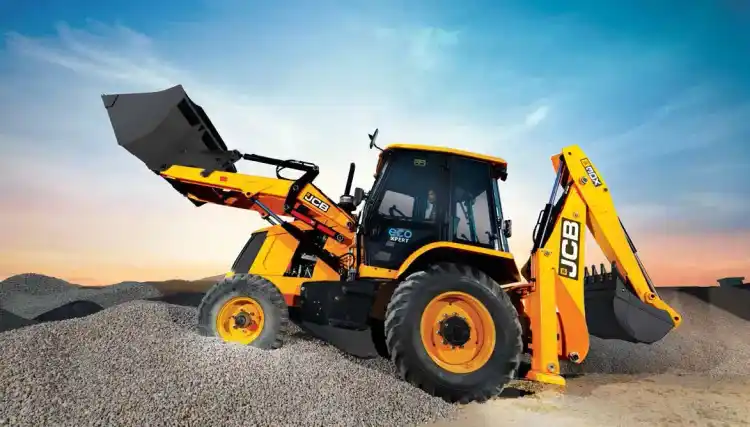
When you plan to buy construction equipment, brochure lists engine’s emission stage under “Engine” section. It usually reads CEV Stage IV or CEV Stage V. But why does this detail matter? India is fighting rising air pollution, so the government now sets strict limits on vehicle emissions. As a result, every buyer should understand what BSCEV emission norms mean and which rules apply.
Below, you will find what the norms mean, how the stages differ and what they change for new and used buyers.
India’s Construction Equipment Emission Norms Explained
In this section, we will understand what BS-CEV emission norms are:
What Are BS-CEV Emission Norms?
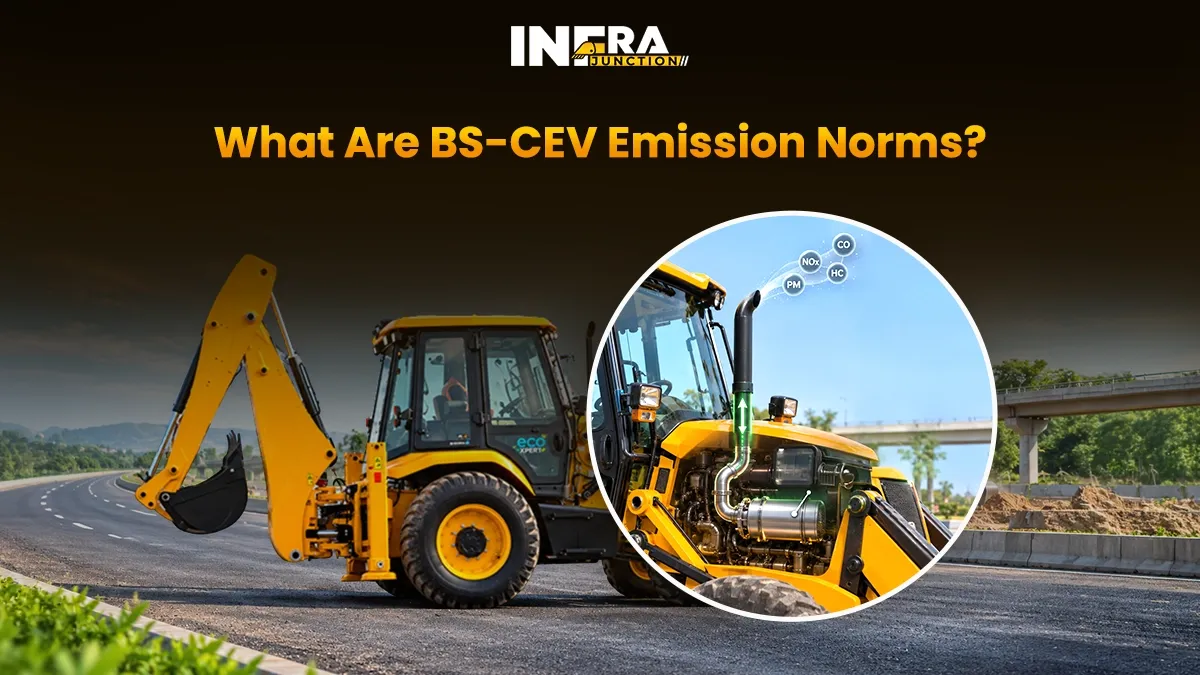
BS-CEV emission norms set limits on the gases and smoke released by a diesel engine. These include nitrogen oxides (NOx), particulate matter, carbon monoxide and hydrocarbons. Ministry of Road Transport and Highways (MoRTH) make these rules for all new construction machines.
CEV stands for Construction Equipment Vehicle. In simple terms, Bharat Stage V and CEV Stage V refer to same emission standard for construction equipment. These rules help reduce harmful emissions from machines, which means less air pollution around construction sites.
CEV Stage III, IV and V: What is the Difference?
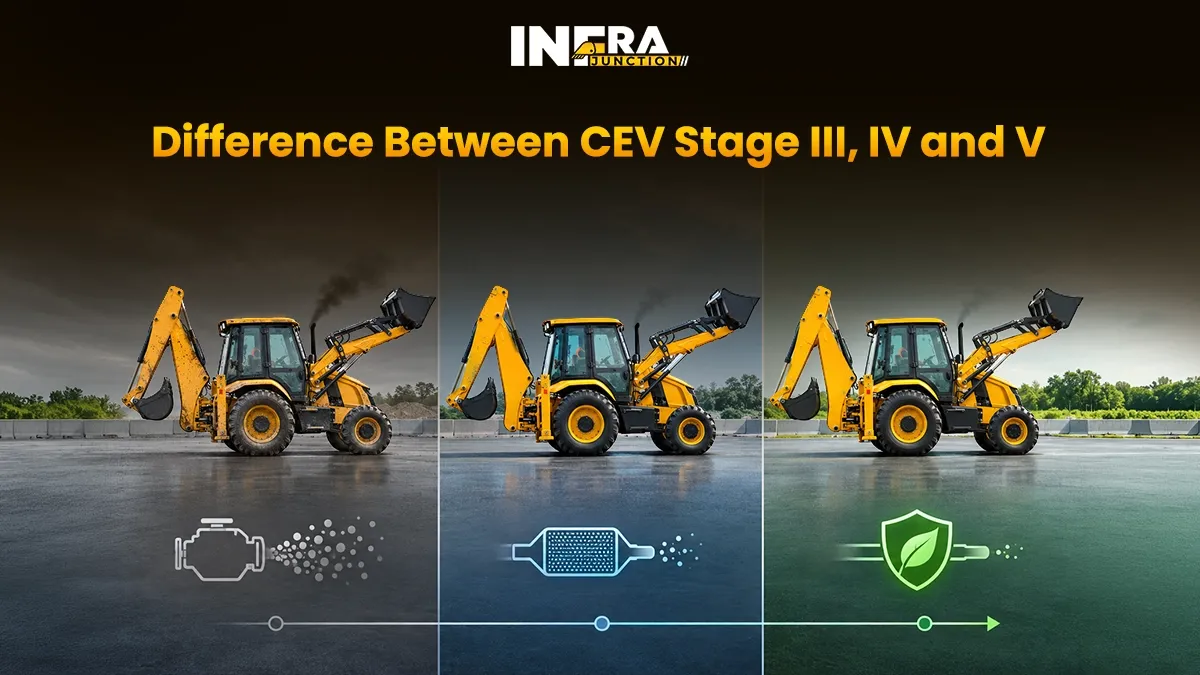
Each new stage introduced stricter emission limits to reduce pollution from construction machines. Here is how the three stages differ:
CEV Stage III: This was older emission standard and followed US Tier 2/3 limits. Most machines used this standard until April 2021.
CEV Stage IV: It came into effect in April 2021 after a delay. It follows EU Stage IV limits and applies to engines ranging from 37 kW to 560 kW.
CEV Stage V: It follows EU Stage V limits and covers a wider range of engines. It also sets a limit on number of particles released by the engine.
However, CEV Stage IV did not cover engines below 37 kW. As a result, smaller machines moved directly from Stage III to Stage V without going through Stage IV.
CEV Stage V Rules From January 2025: What Changed?
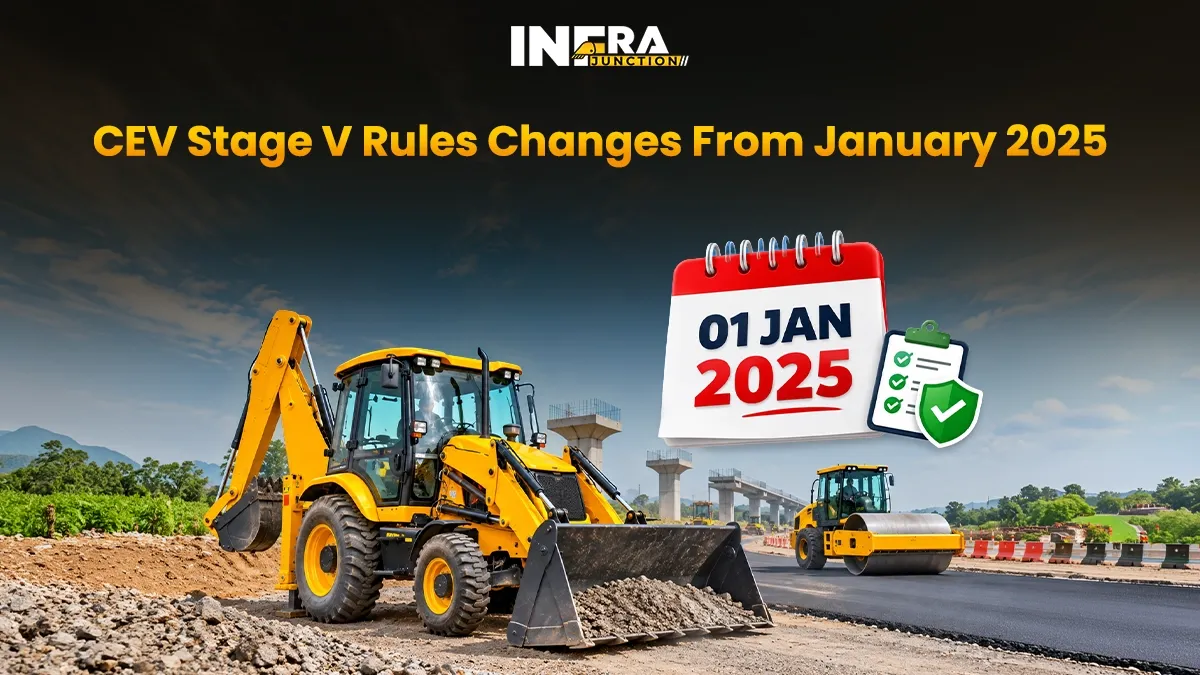
CEV Stage V became mandatory for wheeled construction equipment on 1 January 2025. The government had initially planned to introduce it in April 2024 but later extended the deadline. According to ICRA, wheeled machines account for 65 70% of the industry. This means new emission rules affect most construction equipment buyers.
The main changes under CEV Stage V include:
Stricter limits on particulate matter and particle numbers. To meet these limits, manufacturers now fit diesel particulate filters (DPF) in machines.
New safety requirements under AIS 160, which include protection against rollovers and falling objects.
A 2026 amendment sets 1 October 2026 as the deadline for engines above 56 kW. It also introduces in service emission checks to ensure machines continue to meet emission limits after they start operating.
Do CEV Stage V Machines Need AdBlue (DEF)?
AdBlue, also known as Diesel Exhaust Fluid (DEF), is a urea based liquid that is kept in a separate tank. This liquid is sprayed into the exhaust, together with the SCR system, to reduce harmful NOx gases into N2 and H2O.
But not all machines require AdBlue. An SCR system is used in many larger Stage IV & V engines, and AdBlue is necessary to meet the emission standards. However, smaller engines can comply with emissions standards with just a DPF. Therefore, look in the machine handbook or consult your dealer to see if AdBlue is needed. If it is, continue to use a good quality fluid in the tank. If not, the vehicle could lose power when the AdBlue fuel tank is empty.
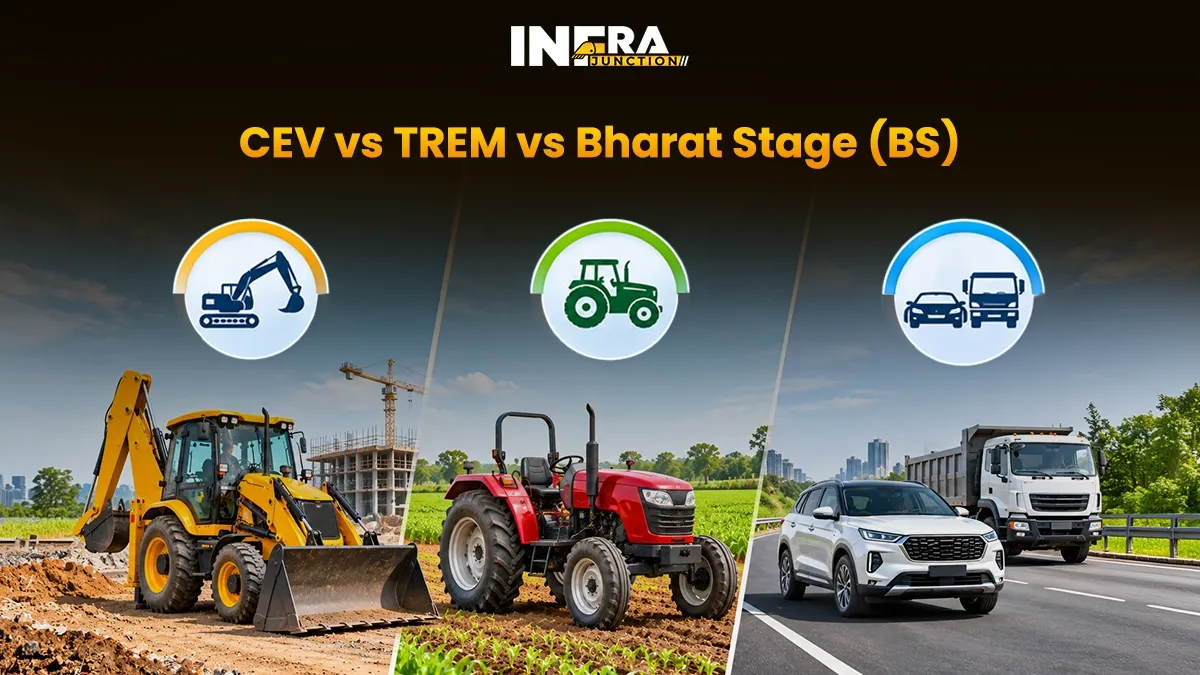
CEV vs TREM vs Bharat Stage (BS)
The terms CEV, TREM and Bharat Stage sound similar, so buyers often get confused between them. However, each one applies to a different type of vehicle or machine.
Bharat Stage (BS): These norms apply to road vehicles such as cars, trucks and buses. The current standard is BS VI.
TREM: These norms apply to agricultural machines such as tractors and combine harvesters.
Before September 2020, agricultural and construction machines followed a common standard called BS (CEV/TREM). Later, the government introduced separate names for both to avoid confusion.
Buying a New CEV Stage V Machine in 2026: Does It Cost More?
Yes, a new CEV Stage V machine generally costs more than older models. According to ICRA, prices may increase by an average of 12-15% across different machine types. Manufacturers usually pass on this cost increase over 12-18 months. However, the actual price difference depends on the machine's previous emission standard.
Stage III to Stage V: The price increase can be higher than 12-15%, especially for engines below 37 kW.
Stage IV to Stage V: The price may increase by around 4-6%.
This price increase is mainly due to additional parts such as DPF and SCR systems. However, these changes are also expected to improve fuel efficiency.
Before buying a new machine, ask your dealer these three questions:
Which CEV emission stage does the engine follow?
Does the machine require AdBlue?
How much will regular servicing and maintenance cost?
Is a Used CEV Stage III or IV Machine Still Legal in India?
Generally, yes. CEV emission rules apply to new machines when they are manufactured and registered. So, a used Construction machine that met the required emission rules when it was built can usually continue to operate legally. However, check its registration papers and engine plate before buying. Also, some areas have restrictions on older diesel machines, so check with your local RTO.
You should also consider the machine's resale value. Buyers are now more interested in machines with newer emission standards. Moreover, finding spare parts for older engines may become difficult over time. Be extra careful when buying imported used machines. Industry bodies have raised concerns that many imported machines do not meet Stage V norms. They have also asked the government to make import rules stricter.
Final Thoughts
BSCEV emission norms now play an important role when buying construction equipment in India. With CEV Stage V, machines have cleaner engines, but their prices are also higher. Some machines also need AdBlue to meet emission limits. However, these changes can help improve fuel efficiency and keep machines compliant with emission rules. Before buying, check the engine's emission stage, compare prices and verify the documents if you are buying a used machine.
Frequently Asked Questions
What are BS-CEV emission norms in India?
BS-CEV emission norms are government rules that set limits on harmful gases and smoke released by construction equipment engines. These norms help reduce air pollution from machines such as excavators, loaders and road rollers.
What is the difference between CEV Stage IV and CEV Stage V?
CEV Stage V has stricter emission limits than CEV Stage IV. It also covers a wider range of engines and sets limits on the number of particles released by the engine.
When did CEV Stage V norms become mandatory in India?
CEV Stage V norms became mandatory for wheeled construction equipment in India on 1 January 2025. The government had initially planned to introduce these rules in April 2024 but later extended the deadline.
Which construction machines come under CEV Stage V norms?
CEV Stage V norms apply to different types of construction equipment, including excavators, backhoe loaders, wheel loaders and road rollers. The rules cover a wider range of engine capacities than the previous stages.
Do CEV Stage V machines require AdBlue?
Not all CEV Stage V machines require AdBlue. Machines with an SCR system need AdBlue to reduce NOx emissions, while some smaller engines can meet emission limits using only a DPF.