If you own a farm, run a rental business or handle earthwork projects, buying a backhoe loader is a major investment. You need a machine that can dig, lift and move materials throughout the day.
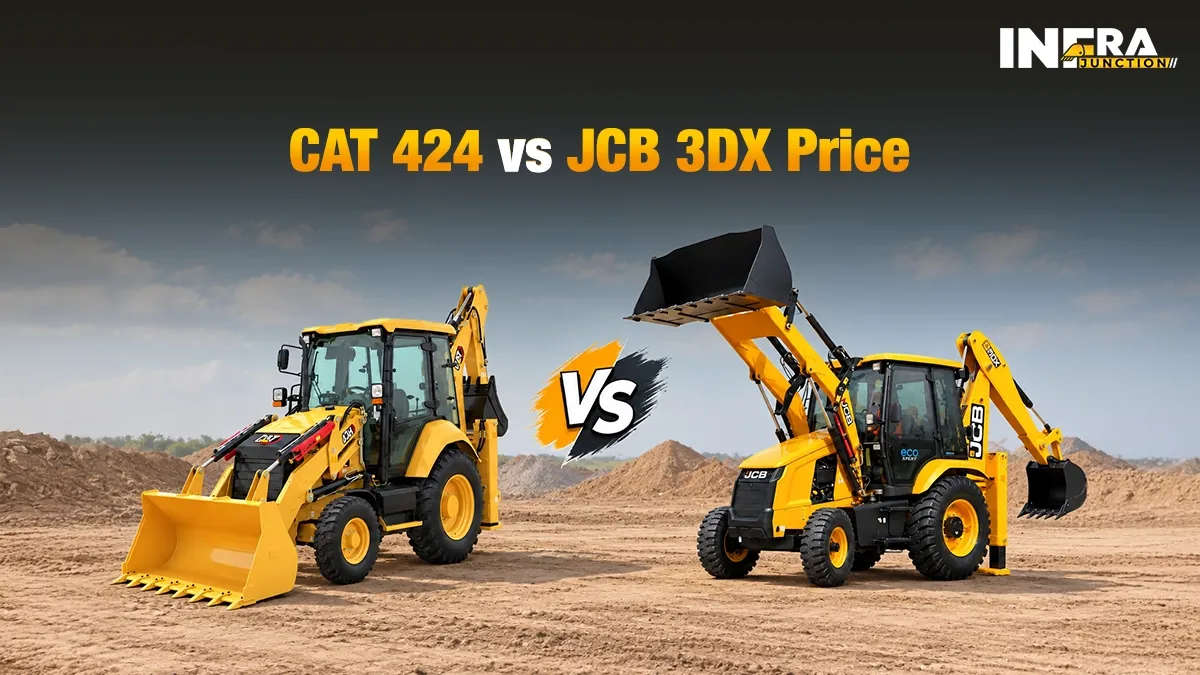
In India, the CAT 424 and JCB 3DX are two backhoe loaders worth comparing. Both can handle digging, loading, trenching and other earthwork jobs, but they differ in engine power, lifting capacity, size and service requirements.
This comparison covers their prices, specifications and key features to help you choose the right machine for your work.
CAT 424 vs JCB 3DX Compared
Let's compare the main specifications of the CAT 424 and JCB 3DX before looking at their performance in different working conditions.
Key Specifications at a Glance
Specification
CAT 424
JCB 3DX
Price
₹34–35 lakh
₹35–38 lakh
Engine Power
75 HP
49 HP
Maximum Torque
424 Nm
270 Nm
Engine Displacement
3,600 cc
3,000 cc
Operating Weight
8,760 kg
7,200 kg
Transport Length
5,708 mm
5,900 mm
Ground Clearance
454 mm
310 mm
Loader Lifting Capacity
3,586 kg
1,490 kg
Dump Height
2,766 mm
2,740 mm
Backhoe Bucket Capacity
0.27 cubic metres
0.26 cubic metres
Maximum Digging Depth
4,707 mm
4,770 mm
Bucket Rotation
205 degrees
185 degrees
Hydraulic Pump Flow
132 L/min
114 L/min
CAT 424 vs JCB 3DX Price
The CAT 424 costs around ₹34–35 lakh, while the JCB 3DX is priced at ₹35–38 lakh. Based on these figures, the CAT 424 has a lower starting price.
However, the purchase price is only one part of the total cost. You should also consider fuel use, servicing, spare parts, machine availability and the number of hours you expect to work each day.
If you plan to use the machine for your own farm, consider the type of digging and loading jobs you handle. For a rental business, compare the work each machine can complete and the demand for it in your area.
Engine and Power
Engine power is one of the biggest differences between these two backhoe loaders.
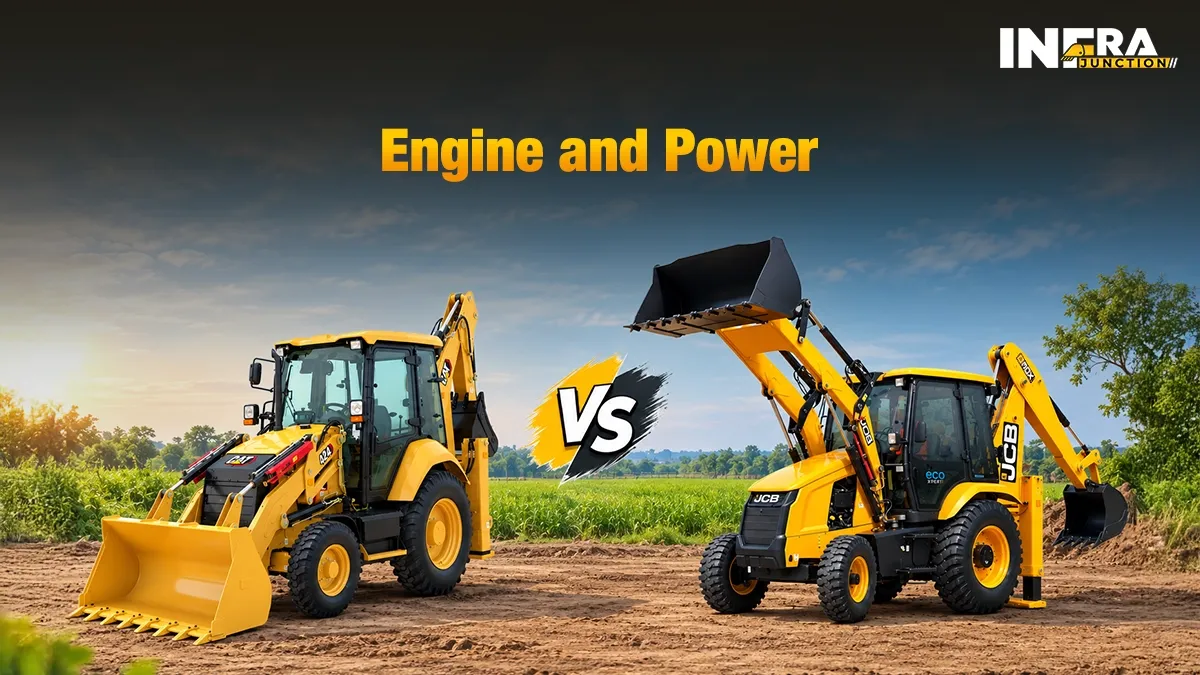
The CAT 424 has a Cat C3.6 engine with a displacement of 3,600 cc. It produces 75 HP (55 kW) and 424 Nm of torque. The engine is turbocharged and intercooled and meets BS V emission norms.
The JCB 3DX comes with a JCB 430 engine with a displacement of 3,000 cc. It produces 49 HP (37 kW) at 2,050 rpm and delivers 270 Nm of torque. The engine meets CEV Stage V emission norms.
The CAT 424 offers 26 HP more power and 154 Nm more torque than the JCB 3DX. This difference may help during demanding digging and loading work, especially when the machine faces heavy loads or hard soil.
The JCB 3DX has lower engine power, which may be sufficient for routine trenching, levelling, loading loose soil and other jobs that do not require as much power.
Before choosing either machine, consider the type of soil at your worksite and the load you need to move regularly.
Weight and Size
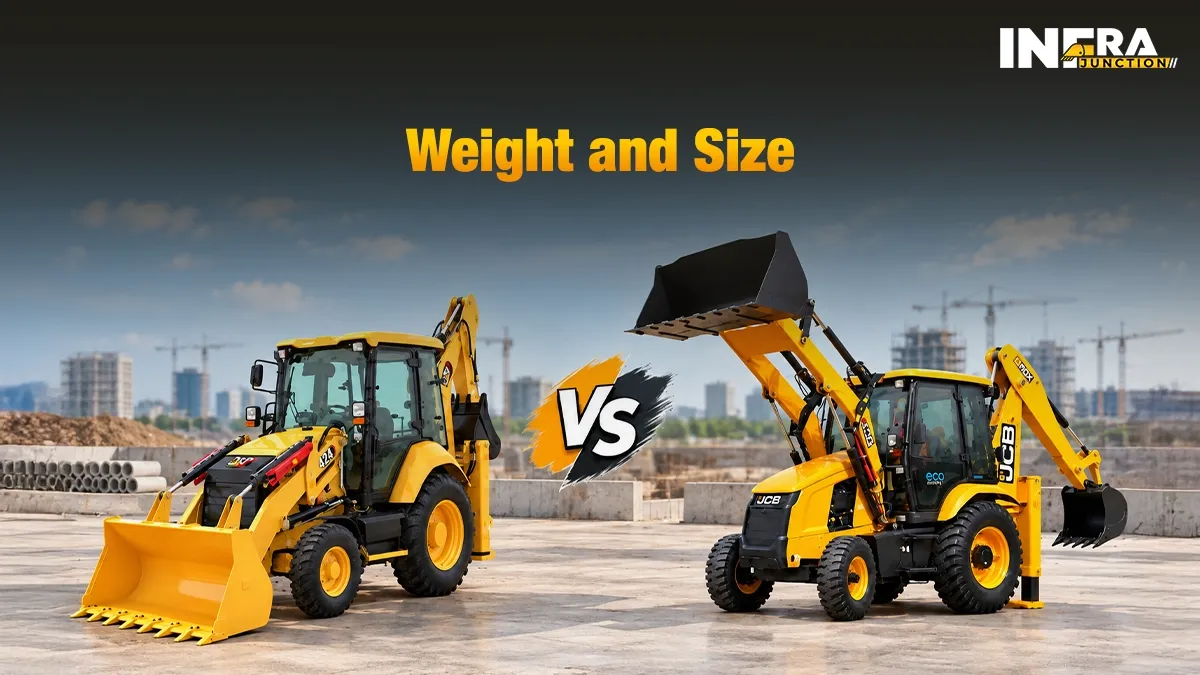
The CAT 424 has an operating weight of 8,760 kg, compared with 7,200 kg for the JCB 3DX.
A heavier machine can offer greater stability during certain digging and lifting operations. However, weight alone does not determine stability or performance. Tyres, axle design, load distribution and ground conditions also matter.
If you work on wet fields or soft soil, check the machine's ground pressure and traction before buying. These factors can affect how easily it moves across the site.
Transport size is another point to consider. The CAT 424 has a transport length of 5,708 mm, while the JCB 3DX measures 5,900 mm. The CAT is shorter, which may help when moving the machine through restricted spaces or transporting it on a suitable trailer.
The cabin heights are similar. The CAT 424 measures 2,928 mm, while the JCB 3DX measures 2,870 mm.
Ground clearance differs more noticeably. The CAT 424 offers 454 mm, compared with 310 mm for the JCB 3DX. Higher ground clearance can help reduce contact with stones, ridges and other obstacles underneath the machine.
Loader Performance: Front Bucket
The front bucket is used for loading and moving materials such as soil, sand, gravel and other loose material.
According to the supplied specifications, the CAT 424 has a loader lifting capacity of 3,586 kg, while the JCB 3DX has a listed capacity of 1,490 kg. This is a substantial difference, but confirm that both figures refer to the same type of lifting capacity before comparing them directly.
The dump heights are close. The CAT 424 has a dump height of 2,766 mm, while the JCB 3DX reaches 2,740 mm.
The JCB 3DX has a slightly greater hinge pin height of 3,540 mm, compared with 3,473 mm for the CAT 424.
Bucket angles also differ. The CAT has a dump angle of 46 degrees and a rollback angle of 39 degrees. The JCB has a dump angle of 38 degrees and a rollback angle of 45 degrees.
A larger dump angle can help empty material from the bucket, especially when the material sticks to its surface. Rollback angle affects how the bucket holds material while travelling. Actual performance depends on the bucket design, material and operating conditions.
If loading forms a large part of your daily work, compare the rated lifting capacity, bucket size and working height with the requirements of your site.
Backhoe Performance: Digging Arm
Both machines have similar backhoe bucket capacities. The CAT 424 has a 0.27-cubic-metre bucket, while the JCB 3DX has a 0.26-cubic-metre bucket.
The JCB 3DX has a maximum digging depth of 4,770 mm, slightly greater than the CAT 424's 4,707 mm. The difference is only 63 mm, so the two machines have similar maximum digging depths on paper.
This capacity may suit jobs such as digging drainage channels, pipe trenches, foundation pits and farm ponds. However, the right choice also depends on the required trench depth, soil conditions and working space.
Bucket rotation is another difference. The CAT 424 offers 205 degrees of rotation, compared with 185 degrees for the JCB 3DX. A wider rotation angle can give the operator more flexibility when positioning the bucket and moving soil.
For regular digging work, compare the digging depth, reach, bucket capacity and breakout force, where available. These details will give you a better idea of how each machine may perform at your site.
Hydraulic System
The CAT 424 uses a closed-centre hydraulic system with a variable-flow axial piston pump. Its listed pump flow is 132 litres per minute. The JCB 3DX has a listed hydraulic pump flow of 114 litres per minute.
The CAT has the higher stated flow rate. However, hydraulic flow alone does not determine how quickly a machine completes a task. System pressure, hydraulic circuit design, control settings and the work being performed also affect performance.
Hydraulic oil capacity is another point to check. The CAT 424 has a listed hydraulic oil capacity of 42 litres, while the JCB 3DX has 110 litres.
The JCB's larger capacity means more oil may be needed when the system requires a complete fluid change. However, actual servicing costs depend on the recommended oil, service intervals and maintenance requirements.
Fuel and Service Capacity
The CAT 424 has a 160-litre fuel tank, while the JCB 3DX has a 128-litre tank. The CAT's larger tank can reduce the need for refuelling stops, depending on fuel consumption and working conditions. However, tank size alone does not tell you which machine uses less diesel.
Ask both dealers for fuel consumption estimates under working conditions similar to yours. This will help you estimate daily fuel expenses more accurately.
Here are the other listed fluid capacities:
Fluid Capacity
CAT 424
JCB 3DX
Engine Oil
9 litres
15 litres
Rear Axle Oil
16.5 litres
20 litres
Transmission Oil
14 litres
17.5 litres
Coolant
20 litres
16.5 litres
The CAT 424 has lower listed capacities for engine oil, rear axle oil and transmission oil. This may reduce the quantity needed during certain fluid changes, but it does not automatically mean lower total servicing costs.
Compare the recommended service intervals, oil grades, filter prices and labour charges before making your decision.
Axle, Steering and Brakes
The JCB 3DX has a front axle oscillation angle of up to 16 degrees, while the CAT 424 has a listed angle of 9 degrees.
Greater axle oscillation can help the wheels maintain contact with uneven ground. However, tyre condition, traction and the type of surface also affect movement and stability.
The JCB 3DX uses power steering with a listed system pressure of 160 bar. Its turning circle outside the bucket is 11,600 mm. The CAT 424 uses front-wheel steering, according to the supplied information. The JCB 3DX also has oil-immersed multi-disc brakes on the rear axle. This brake design helps protect braking components from external dirt and water.
Both machines use 16.9 × 28 rear tyres. The JCB 3DX has 9 × 16 front tyres with a 16 PR rating.
If you regularly work on uneven fields, narrow roads or restricted construction sites, check the turning space, steering response, braking system and tyre options before choosing a machine.
Who Should Buy the CAT 424 or JCB 3DX?
Choose the CAT 424 if:
You need higher engine power and torque for demanding work.
Your jobs involve frequent loading and heavy material handling.
Higher ground clearance is useful at your worksite.
You want a larger fuel tank and higher listed hydraulic pump flow.
The quoted purchase price is lower than that of the JCB 3DX.
Choose the JCB 3DX if:
Your daily work mainly involves routine digging, trenching, levelling and loading.
You prefer a machine with a lower operating weight.
Greater front axle oscillation suits the uneven surfaces you work on.
The listed digging depth and bucket capacity meet your job requirements.
Its local service support, spare parts availability and operating costs suit your business.
If you plan to rent out the machine, consider which model local contractors prefer and what types of jobs are common in your area. A machine that matches local demand may help you secure more work.
For farm use, focus on the soil conditions, access roads, digging requirements and annual working hours. The right choice depends on the work you do most often, not just the engine power or purchase price.
Frequently Asked Questions
1. Which is more powerful, CAT 424 or JCB 3DX?
The CAT 424 is more powerful, with 75 HP and 424 Nm of torque. The JCB 3DX produces 49 HP and 270 Nm of torque.
2. Which backhoe loader has a higher lifting capacity?
The CAT 424 has a listed loader lifting capacity of 3586 kg, while the JCB 3DX has 1490 kg.
3. Which has better digging depth, CAT 424 or JCB 3DX?
The JCB 3DX has a slightly greater digging depth of 4770 mm, compared with 4707 mm for the CAT 424.
4. Which backhoe loader has a bigger fuel tank?
The CAT 424 has a 160-litre fuel tank, while the JCB 3DX has a 128-litre tank.
5. Which backhoe loader is better for heavy farm work?
The CAT 424 is better suited to heavy farm work because it offers 75 HP, 424 Nm of torque, 3586 kg loader lifting capacity and 132 L/min hydraulic flow.